
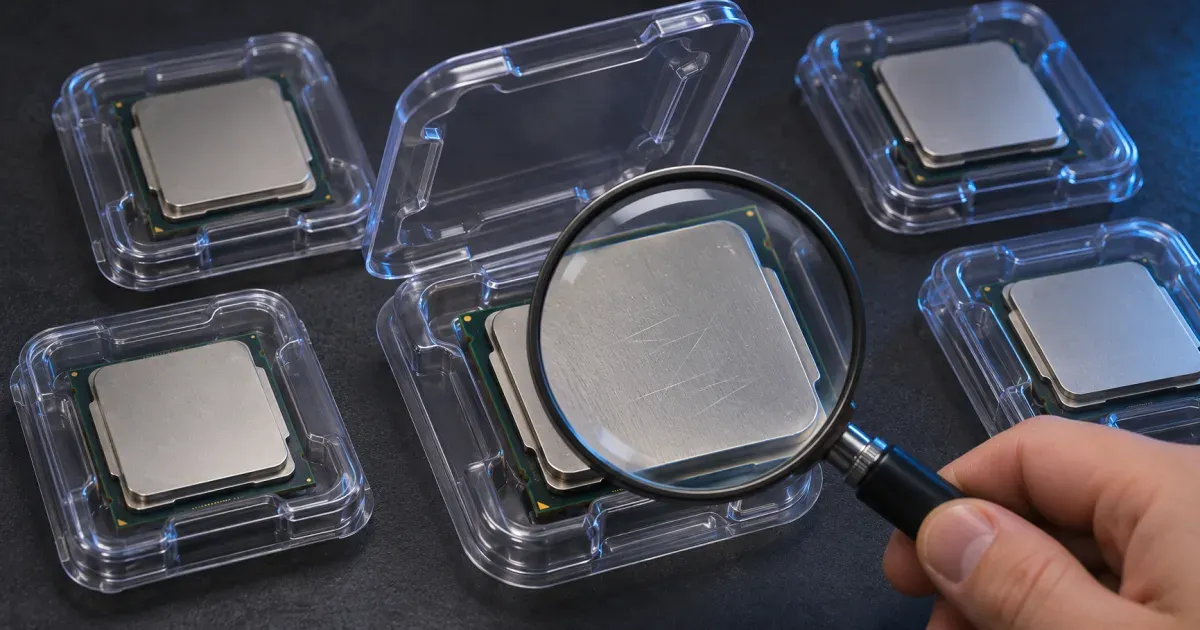

Wondering where to buy used CPU deals without getting burned? The best place depends on how much risk you can accept. For most people, eBay is the safest all-round choice because its Money Back Guarantee covers items that arrive broken or not as described. Amazon Renewed and dedicated refurbishers cost a little more but add longer guarantees. r/hardwareswap and local marketplaces usually have the lowest prices, but you carry more of the risk yourself.
Used CPUs are one of the safest used PC parts you can buy. A processor has no moving parts, and a chip that works on day one usually keeps working for years. The real risks are not wear and tear. They are scams, bent pins, wrong models and missing return options. This guide compares where to buy, how to avoid bad listings, and exactly how to test a used CPU the day it arrives.
Table of Contents
Where to Buy a Used CPU: Quick Answer by Buyer Type
- You want the most protection: eBay (from sellers with strong feedback) or Amazon Renewed.
- You want the lowest price and know what you are doing: r/hardwareswap or local pickup on Facebook Marketplace, OfferUp or Craigslist.
- You want a tested part with a store guarantee: a refurbisher or specialist used-parts store.
- You are buying a server or workstation CPU (Xeon, EPYC): eBay and specialist sellers, because these chips are rarely sold locally.
A practical rule many builders follow: pay a small premium on a platform with returns and buyer protection. On a $30 CPU, saving $5 is not worth losing the whole $30 if the chip is dead.
Used CPU Marketplaces Compared
| Where | Buyer protection | Prices | Best for | Main risk |
|---|---|---|---|---|
| eBay | Strong (Money Back Guarantee) | Fair to good | Most buyers | Inaccurate listings from low-feedback sellers |
| Amazon Renewed | Strong (90-day guarantee) | Higher | Buyers who want easy returns | Limited CPU selection |
| r/hardwareswap | PayPal Goods & Services only | Often lowest | Experienced buyers | No platform warranty; scams if rules are ignored |
| Jawa | Short dispute window | Fair | US gamers buying parts or full PCs | Only 2 days to report problems |
| Facebook Marketplace, OfferUp, Craigslist | Little to none for cash deals | Low | Local pickup where you can test first | Scams and no recourse |
| Refurbishers and specialist stores | Store warranty or guarantee | Fair | Buyers who want a tested part | Quality varies by store |
eBay
eBay has the biggest selection of used CPUs, from budget desktop chips to server processors. Its main advantage is buyer protection. Under the eBay Money Back Guarantee, a buyer who receives the wrong item, or an item that arrives broken or faulty and wasn’t described that way, can return it for a refund even if the seller doesn’t offer returns. You generally have 30 days from delivery to open a case.
The catch is listing quality. Read the condition field carefully: a CPU listed “for parts or not working” is not covered as a working item. Stick to sellers with long, positive feedback histories and listings that show photos of the actual chip.
Amazon Renewed
Amazon Renewed products come with a guarantee that lets you return the item within 90 days of receipt for a replacement or refund. That is three times longer than most marketplaces. The downside is selection: you will find far fewer standalone CPUs here than complete PCs and laptops, and prices are usually higher. Check that the listing actually says it is covered by the Renewed Guarantee.
r/hardwareswap
r/hardwareswap is a Reddit community where enthusiasts buy and sell parts directly. Prices are often the lowest anywhere, and sellers build a public trade history through a flair system. The subreddit’s rules exist to protect you: sellers must post timestamped photos of the item, and the community only allows payment methods with protection. PayPal Friends & Family is banned for good reason, because it gives you no way to get your money back.
Never agree to pay any other way than PayPal Goods & Services, and check the seller’s confirmed trade count before you pay.
Jawa
Jawa is a US marketplace built specifically for PC parts and gaming PCs. Payments are held until you confirm the item arrived, and sellers have public ratings. The important limit is time: Jawa gives buyers up to 2 days after delivery to dispute an item, after which the seller is paid. If you buy a CPU there, have a motherboard ready to test it the day it lands.
Facebook Marketplace, OfferUp and Craigslist
Local marketplaces can have excellent prices, especially from people selling the parts of an upgraded PC. The best way to use them is local pickup with a test: ask to see the CPU running in the seller’s PC, with the BIOS or Windows system information on screen showing the exact model. Cash deals have essentially no buyer protection, so meet in a public place and never pay a deposit to a stranger.
Refurbishers and specialist used-parts stores
Refurbishers and specialist stores sit between marketplaces and retail. You pay a little more than on r/hardwareswap, but the store stands behind the sale with its own guarantee. When you compare stores, look for three things: a clear condition description, real photos of the item, and a written return or money-back policy.
Full disclosure: Bethel Tech is one of these stores. We sell pre-owned and new-old-stock CPUs such as the AMD Ryzen 3 2200G, the Intel Core i7-10700F and the AMD EPYC 7261, with free shipping to the US, UK, Canada, Australia and New Zealand and a 14-day money-back guarantee. Whether you buy from us or anyone else, use the checklist below.
How to Avoid Scams and Bad Listings When Buying a Used CPU
Most used-CPU problems can be spotted before you pay. Check every listing for these points:
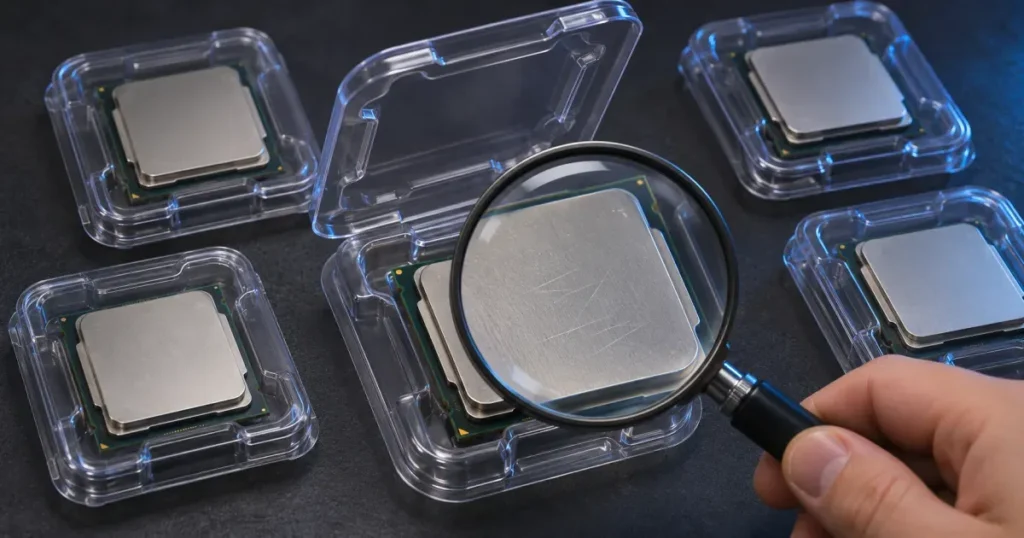
- Exact model and photos of the real chip. The model number printed on the heat spreader (for example “i7-10700F” or “2200G”) should match the title. Stock photos alone are a warning sign.
- Pins or pads in focus. For AMD AM4 chips, the pins are on the CPU, so ask for a clear photo of the underside. For Intel LGA chips and AMD AM5, the pins are in the motherboard socket, so the CPU’s contact pads should be clean and undamaged.
- A price that makes sense. If a CPU is listed far below every other used listing, assume something is wrong.
- Safe payment. Pay through the platform or with PayPal Goods & Services. Never use gift cards, crypto, wire transfer or Friends & Family.
- Seller history. Look for an established account with feedback for similar items.
- Vendor lock on server CPUs. Some used AMD EPYC chips are locked to one server brand (often called PSB or vendor lock) and will not boot in other motherboards. Only buy EPYC listings that clearly say “unlocked” or “no vendor lock” unless you own that exact brand of server.
- Engineering samples. Chips marked “ES” or “QS” are pre-release samples. They can be cheap and interesting, but compatibility and stability are not guaranteed, so avoid them for a main PC.
Check compatibility before you buy
A used CPU is only a bargain if your motherboard supports it. Confirm the socket (for example AM4, LGA1200 or SP3), then check your motherboard maker’s CPU support list. Older boards may need a BIOS update before they recognize a newer chip, and some BIOS updates need a supported CPU already installed.
What to Do After a Used CPU Arrives: Verification and Stress Testing
Test immediately, while your return window is still open. This takes about an hour:
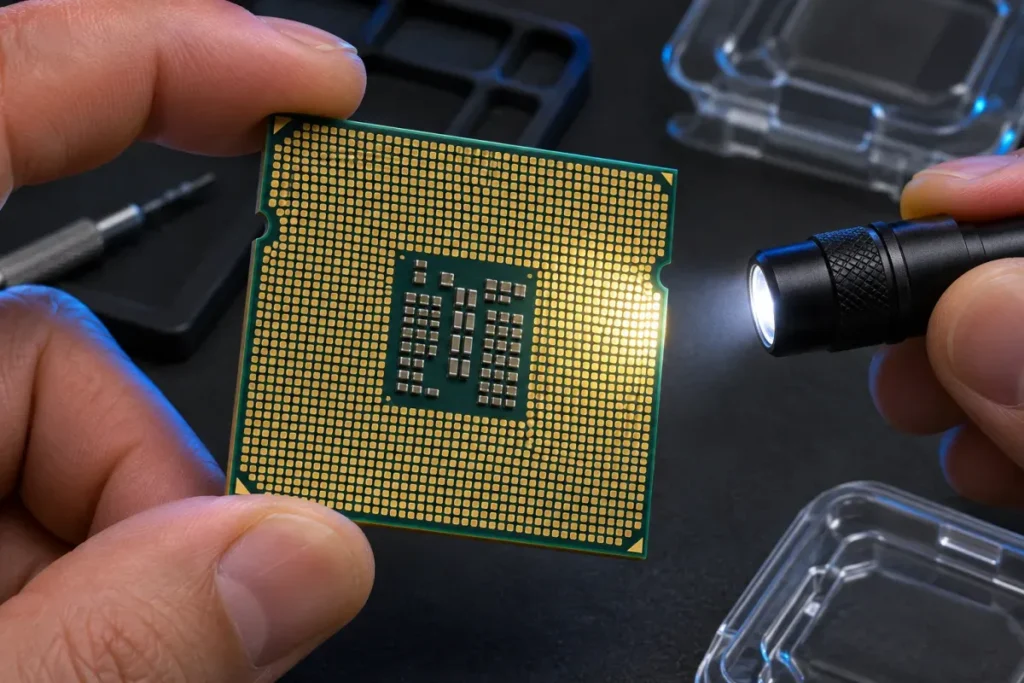
- Inspect it. Check the model printed on the CPU and look closely at the pins or pads with a flashlight. Bent AM4 pins can sometimes be straightened carefully, but report damage to the seller before you try anything.
- Clean and install. Remove old thermal paste from the heat spreader with isopropyl alcohol, then apply fresh paste. See our guide on how much thermal paste to apply. If paste ever gets into the socket or pins, here’s how to clean thermal paste out of a CPU socket.
- Check the BIOS. The BIOS should show the correct CPU name, core count and memory.
- Confirm the details in Windows. A free tool such as CPU-Z shows the exact model, core and thread count, and clock speeds. Compare them with the manufacturer’s specifications.
- Run a stress test. Run Cinebench for a few multi-core passes, then a longer stability test such as OCCT or Prime95 for 30 to 60 minutes. Watch temperatures with a monitoring tool such as HWiNFO.
- Look for red flags. Crashes, freezes, errors, cores missing, or temperatures far above normal for that chip with a decent cooler all mean you should contact the seller right away.
If the CPU passes these tests, it is very likely to be fine for the long term.
Used CPU Price Expectations by Tier
Used prices change constantly, so treat these as a rough guide based on typical used listings at the time of writing, not fixed prices:
| Tier | Example CPUs | Typical used price range | Good for |
|---|---|---|---|
| Budget with integrated graphics | AMD Ryzen 3 2200G, Ryzen 5 2400G | About $20–40 | Office PCs, media PCs, first builds without a graphics card |
| Older mainstream gaming | Ryzen 5 2600 / 3600, Intel Core i5-10400 | About $40–80 | Budget gaming PCs and upgrades |
| 8-core desktop | Intel Core i7-10700F, Ryzen 7 3700X | About $100–175 | Gaming plus streaming, editing and multitasking |
| First-gen server | AMD EPYC 7261, older Xeons | About $20–40 | Homelabs, NAS and virtualization servers |
Two things move prices the most: whether a chip is still a popular upgrade for an existing socket (such as AM4), and how many are flooding the market from retired office PCs and servers. Server CPUs are cheap mainly because the motherboards and memory they need cost much more than the chip.
Used vs New CPU: When Buying Used Is the Smarter Choice
Buying used makes the most sense when:
- You are upgrading an existing platform. Dropping a faster used chip into your current motherboard is often the cheapest performance upgrade you can make.
- The model is discontinued. Many great chips for older sockets are no longer sold new, so used is the only option.
- You are on a tight budget. One Reddit user put it simply: when you start looking at builds under $1,000, you get much better value buying used. See our picks for the best budget CPU for gaming, new and used.
- You are building a homelab or server. Used server CPUs offer huge memory and expansion support for very little money.
Buying new is the better choice when you need the full manufacturer warranty, are building on the newest platform, or the price gap between new and used is small. For current-generation chips, used discounts are often modest, so the warranty is worth paying for.
Whichever you choose, don’t forget the basics: a good cooler and fresh thermal paste. Our best thermal paste for CPU guide covers which compounds are worth buying, and you can browse all our used and new-old-stock CPUs.
Frequently Asked Questions
Is it better to buy a used or new AMD CPU?
For older AMD platforms such as AM4, used is usually the better value, and many models are no longer sold new. For the newest AMD chips, the used discount is often small, so buying new with a full warranty usually makes more sense.
Which sites sell refurbished or used CPUs for budget builds?
eBay has the widest selection and buyer protection. Amazon Renewed offers a 90-day guarantee but fewer CPUs. r/hardwareswap and local marketplaces are cheapest but riskier. Specialist used-parts stores sell tested CPUs with their own guarantees.
My budget is tight. Should I buy used?
Yes, a used CPU is one of the safest ways to stretch a tight budget, because processors rarely wear out. Buy on a platform with buyer protection and test the chip as soon as it arrives.
Is eBay or Facebook Marketplace better for used CPUs?
eBay is safer for shipped purchases because of its Money Back Guarantee. Facebook Marketplace can be cheaper for local pickup, but it is best when you can see the CPU running before you pay cash.
How can I tell if a used CPU listing is safe to buy?
Look for photos of the actual chip showing the model number, clear photos of the pins or pads, a realistic price, an established seller and protected payment. Avoid listings that only use stock photos or ask for unprotected payment.
Do used CPUs come with a warranty?
Usually not from the manufacturer. Protection comes from the platform or seller instead: eBay’s Money Back Guarantee, Amazon’s Renewed Guarantee, or a store’s own return or money-back policy. Always check the terms before you buy.
Do used CPUs wear out?
Very rarely. CPUs have no moving parts. Unless a chip was heavily overclocked with high voltage for a long time, or physically damaged, a used CPU that passes a stress test should last for many years.